The first possible answer

Do you think there is one single truth? How about one single answer? A definitive version of right?

Our explanation of our existence and the decisions that we make is defined by our retrospective analysis. Our psychology such that we create a narrative that supports our past conclusions. Only sometimes do we reflect and say, “what if?” and then when we feel external factors have left us short-changed.

Ironically at the same time we base our current thinking and decisions on our past. The past that we have rewritten to justify the decisions that we’ve made, becomes the foundation for our future direction. It’s a perfect circle of deception.

The product of this is that we tend to stop at the first possible answer. Our organisations are run by people that rely on this, which is why we struggle with genuine diversity of ideas and look for consensus. When we tend to have shared history, shared retro-perspective, we form more of the same conclusions. It makes things…..quicker.

But what is the probability that the first possible answer, is always the right one? Or even the best one?

Learning to ask the “what if” before rather than after, learning to listen to different views, learning to understand that our perspective is based on our rewriting of the past and that the more that we surround ourselves with people with similar pasts, the more we are likely to reinforce our single perspective. Could any of this help us make better decisions?

In science we talk about the null hypothesis. When we reject it without disproving its basis, we invalidate our research. Yet in business, we call it being commercial and agile, strong leadership.

Trying asking “what if” now and not after and see whether that moves you past your first possible answer. You might be surprised by the results.
We get the leaders we deserve

Many, many years ago I was sat in a room with a CEO and a number of their employees, it was a “meet the ordinary people” type affair. There was a debate about the visibility and availability of the CEO in the various parts of the business, with one of the managers saying that she would like to see them spend more time out on the floor with her team.

It’s the kind of challenge that you hear pretty regularly raised towards leaders and leadership teams. What struck me, on this occasion, was the reply of the CEO.

They went on to explain that they’d very much like to do so. That they’d love to have the opportunity to get to speak to people and interact with them. But they found it really hard to just roll up out of the blue and just start talking and people never really invited them to anything that was going on to help them overcome this challenge.

You mean, CEOs have weaknesses? Well, of course they do. We all do and just because you’ve risen to a position of power doesn’t mean you’re perfect. In the kitchens and copier rooms across the country, we’re busy identifying and outlining the weaknesses of our management teams. We’re incredibly good at diagnosing and highlighting the shortcomings, but what are we doing to help them?

That’s their problem though, you’re not paid to make them better. Right? If you work in HR, I’d thoroughly dispute this but in fact I’d dispute it wherever you work. In many ways, you get the leaders you deserve.

Think about that meeting when you struggled with the P&L for the investment proposal. How would it have felt if someone from finance had come up to you afterwards and kindly offered to take you through the numbers to make sure you were up to speed? What about the time that you were struggling to get your point across in that important meeting? What if someone had asked you questions to help you break it down?

It doesn’t matter what level you are, what seniority you are, how much experience you have, you’re going to have areas of weakness and you’re most likely going to know about them. People pointing them out is often little help, being told what you already know never is. But having people around you quietly helping you to work on them and improve? That’s altogether a different matter.

So next time you want to have a moan about the way your manager, boss or CEO behaves, also ask yourself what you could do to help them cover off that area and be better. You might be surprised by the result you get from them, and maybe also how you feel about yourself and your work.

The hierarchy of HR needs

As a business function we exist to add value to our organisation and their employees. If you ask any experienced HR professional where they would like to add value, you’ll most likely be told in a more “strategic” space. Ask a CEO the same question and you’ll probably hear much the same answer.

So if the desire is from both sides, what gets in the way?

Putting aside questions of capability to deliver at this level for the moment, the answer lies in the hierarchy of HR needs and HR delivery. Put simply, we try to do too much too soon, without delivering on the basics.

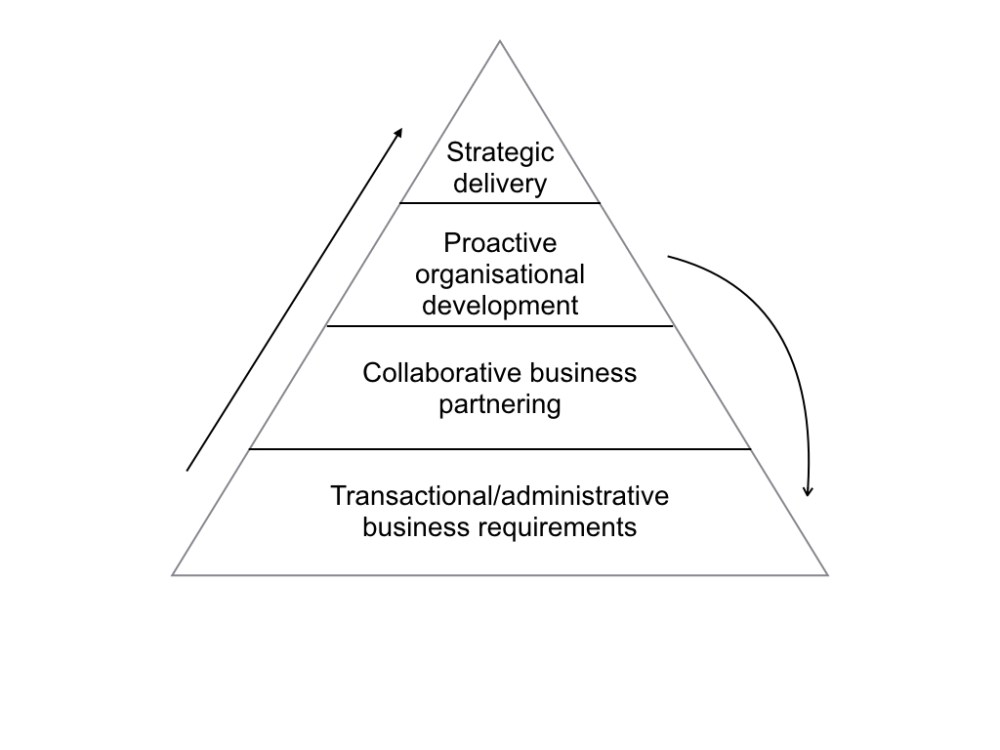
Let’s consider a simple HR hierarchy,

HRhierarchy.001First we need to fulfil the basic reactive, administrative personnel tasks that represent most employees’ experience with the business. The recruitment, the payroll, the benefits administration and grievance, disciplinary and performance management.

Next comes partnering. By this I mean working collaboratively with business leaders to tackle the issues that arise in a broad range of areas on a day to day basis. This isn’t just implementing th administration, but understanding the issues and helping to form solutions.

Once we’ve got this we can use it to inform the development of more proactive organisational interventions that are underpinned by, and drive the design of, the basic, reactive administrative tasks that form the base of our value proposition. In some ways, these first three stages operate as a continuous loop.

This is also the stage where we can start to successfully implement technology solutions to automate the interventions, but based on the organisational understanding that comes through true partnering.

Finally comes strategic delivery. With the three stages below working and constantly informing one another, we can use this feedback loop to help understand our strategic capability.

We can understand the gaps that exist between our future requirements and current capabilities, we have the data and insight that allows us to understand the steady state performance and we can use our knowledge to help connect this to the external opportunity.

Being strategic isn’t a goal in itself, it’s an outcome. If we can build our capability based on this simple model, then we can help more people deliver what we, and our CEOs, most desire.

Not a bad challenge to address as we start the New Year.

The questions for 2016

No, don’t worry…..it’s not a predictions post. I’ll leave that to Laurie and others who’ll do it better.

It’s nearly Christmas and I’m done. I could crack out another couple of posts for you on a Monday morning, but frankly I’m tired and you’re tired of me.

I don’t blame you.

I’m off to reflect for a few weeks, recharge the batteries and come back with more inane babbling and half baked ideas in 2016.

In the meantime, here’s the stuff that’s going to be going round in my head,

  • Is technology the driver of our low productivity?
  • Will wellbeing be the end of engagement?
  • Should you only allow people to recruit who have a growth mindset?
  • Will the Living Wage result in an increasing geographical divide?
  • How do we get a grand coalition of disciplines to tackle the future of work?
  • Are we living in increasingly changing times, or do we just have more information?
  • If Big Data is the future, when is it going to dish up some answers?

And of course, in these festive times…..as an atheist, does my insurance cover an act of God?

More on this anon. Have a wonderful festive period, enjoy the break and allow others to enjoy it too.

Peace out.