The hierarchy of HR needs

As a business function we exist to add value to our organisation and their employees. If you ask any experienced HR professional where they would like to add value, you’ll most likely be told in a more “strategic” space. Ask a CEO the same question and you’ll probably hear much the same answer.

So if the desire is from both sides, what gets in the way?

Putting aside questions of capability to deliver at this level for the moment, the answer lies in the hierarchy of HR needs and HR delivery. Put simply, we try to do too much too soon, without delivering on the basics.

Let’s consider a simple HR hierarchy,
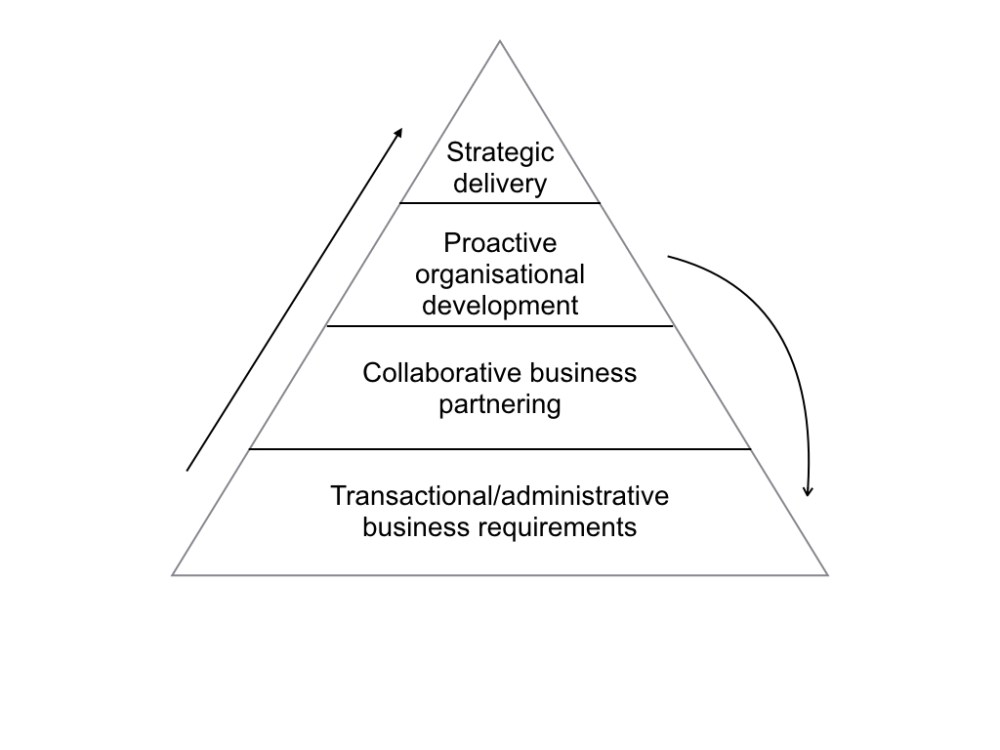
HRhierarchy.001First we need to fulfil the basic reactive, administrative personnel tasks that represent most employees’ experience with the business. The recruitment, the payroll, the benefits administration and grievance, disciplinary and performance management.

Next comes partnering. By this I mean working collaboratively with business leaders to tackle the issues that arise in a broad range of areas on a day to day basis. This isn’t just implementing th administration, but understanding the issues and helping to form solutions.

Once we’ve got this we can use it to inform the development of more proactive organisational interventions that are underpinned by, and drive the design of, the basic, reactive administrative tasks that form the base of our value proposition. In some ways, these first three stages operate as a continuous loop.

This is also the stage where we can start to successfully implement technology solutions to automate the interventions, but based on the organisational understanding that comes through true partnering.

Finally comes strategic delivery. With the three stages below working and constantly informing one another, we can use this feedback loop to help understand our strategic capability.

We can understand the gaps that exist between our future requirements and current capabilities, we have the data and insight that allows us to understand the steady state performance and we can use our knowledge to help connect this to the external opportunity.

Being strategic isn’t a goal in itself, it’s an outcome. If we can build our capability based on this simple model, then we can help more people deliver what we, and our CEOs, most desire.

Not a bad challenge to address as we start the New Year.

The questions for 2016

No, don’t worry…..it’s not a predictions post. I’ll leave that to Laurie and others who’ll do it better.

It’s nearly Christmas and I’m done. I could crack out another couple of posts for you on a Monday morning, but frankly I’m tired and you’re tired of me.

I don’t blame you.

I’m off to reflect for a few weeks, recharge the batteries and come back with more inane babbling and half baked ideas in 2016.

In the meantime, here’s the stuff that’s going to be going round in my head,

  • Is technology the driver of our low productivity?
  • Will wellbeing be the end of engagement?
  • Should you only allow people to recruit who have a growth mindset?
  • Will the Living Wage result in an increasing geographical divide?
  • How do we get a grand coalition of disciplines to tackle the future of work?
  • Are we living in increasingly changing times, or do we just have more information?
  • If Big Data is the future, when is it going to dish up some answers?

And of course, in these festive times…..as an atheist, does my insurance cover an act of God?

More on this anon. Have a wonderful festive period, enjoy the break and allow others to enjoy it too.

Peace out.

The power of five

Five years ago, I posted my first blog post on this site. One of the worst kept secrets in HR blogging is that I used to run a different site with a little more “artistic freedom”..…but enough about that for now. Five years is a pretty long time in this modern world, things change and move on. So what’s changed in that time and what has (maybe unsurprisingly) stayed the same?

The mystery of performance management – ironically, the first post I wrote here was about the need to take a more human approach in performance management. So is the fact that corporate after corporate is rushing to deliver the headline grabbing news that they’re ditching their annual appraisals evidence that this is happening? Absolutely not. It’s all a load of bull and they’ll be silently reintroducing some sort of system in the next two years. The point isn’t that you don’t need any system, it’s that you need a human system. Two very different points with two very different outcomes. VERDICT: NO CHANGE

The death of Human Capital Management – Not long after my first post, I wrote an attack on Human Capital Management. It was probably the first post that I wrote that caught the attention. It’s a phrase and a term that is only beaten into second place in the hall of shame by Employee Engagement (more of that later). HCM and human capital metrics are as 1980s as my fashion sense….and neither needs to be subjected to the masses. Fortunately, big data has replaced HCM as the numptiness of choice. VERDICT: DEAD AND BURIED

Ethical business, trust and authenticity – A theme over the last five years has been around ethics, trust and authentic business management. Don’t get me wrong, I”m an unashamed capitalist…BUT that doesn’t mean I think we need to rip a second a**e in each of our employees. For too long big, corporate FTSE100 businesses have lied and lied and lied some more. The string of corporate failures over this time have shown us that this is’t rhetoric, but simple truth. And in return we’ve seen and increasingly humble and apologetic approach. A new dawn? Don’t you believe it. Just a pause, the vultures are circling higher than before, but don’t believe they won’t be back. VERDICT: CEASEFIRE

The engaged employee – I said I’d be back to it, so why the surprise? Engagement is simply the most poisonous and frankly dangerous management concept of the last ten years. It makes the Ulrich Model look like a warm, soapy cuddle in the bath. Put simply, in the time that we have been talking about employee engagement, the happiness of employees has decreased. That’s not me talking, that’s a fact. And yet we persist. That’s either stupidity, or insanity. VERDICT: STILL BREATHING, BUT FIRST UP AGAINST THE WALL

Our profession and our professional body – Ok, so I know this one is going to be thrown back in my face *assumes the position*, but I have more confidence in both the HR professional and the CIPD than I’ve had since I graduated back in 1864. We’re generally talking about the right things, we’re willing to have an open debate and discussion and we are hearing voices from outside of the small select group of organisations that previously dictated the agenda. It’s promising, really promising. But not time to pop the champagne just yet. VERDICT: ON THE UP

I’m not going to dwell on HR, social technology and the like. You can read that in countless free “books”, but five more years? I doubt it. By then I’ll be transmitting direct in to your brains. So enjoy the freedom whilst you have it my friends…

I’m saving the good stuff for then.

Disrupting HR?

I wish I could be like the cool kids, all the cool kids seem to disrupt…..

You know when even the establishment talks about disrupting that you’re seriously missing out. That somehow there is a boat that has sailed, you didn’t even managed to work out was in the harbour.

Everyone is disrupting. We’re disrupting the disruption that was disrupted in the last great disrupt. We’re so disruptive that we’ve forgotten what exactly it was that we were trying to do and why.

Or alternatively, we’re enthusiastically employing the lexicon of another world without really understanding what it is we’re talking about and why.

Do we need to disrupt HR? I guess it depends on what you think HR is.

If you think that HR is a series of processes and policies and procedures. If you think that HR is a static system of interventions that exist in isolation of the organisational ecosystem. If you think that HR is a practice which has failed to evolve, develop and adapt.

Then yes, maybe you do want to disrupt that.

But do you think that? Is that what we really think our profession is? A set of processes. Is that the value you add? When you talk about disruption, is that what you wish to disrupt?

What if HR is the strategic approach to managing people to deliver business performance. If it is about helping people to be better, be happier and deliver more. If it is about creating an adaptive system that changes, develops and grows as part of the organisational system within which it exists.

Do you really want or need to disrupt that?

I’m all for better. I’m all for evolution. I’m all for improvement.

The funny thing about successful organisations, successful practices is that they change, develop and evolve before the need to disrupt them occurs.

Maybe there are areas of our world that need a shake up. But let’s stop the lazy deployment of terms that we don’t really understand and don’t really mean, just to keep in with the in crowd.

You go ahead and disrupt if you really want to, I’m going to adapt, develop and grow.

And when the dust settles, we’ll see who’s further ahead.

You may be invincible, I’ll be in the background.

And that’s ok.