The end of 2016

So, here we are. Coming to the end of 2016 and for me, the last time this year that I’m going to sit down and write.

Glad it’s over?

Yeah, the prevailing view seems to be that 2016 has been a bit of a sucky year. But I’m not so sure. Beyond the hype and the hyperbole, the media column inches, I see some good things out there, things that warrant a mention.

The first round the world solar-powered flight – This is serious game changing technology. We might be having arguments about who runs this and who runs that. But that all seems pretty pointless if the actual planet that we’re on is going to hell in a handcart. Step forward Bertrand Piccard and Solar Impulse 2. Now imagine if we replaced all of the flights taking place across the world with solar-powered planes and the impact that would have on our ecosystem. I’m not saying that is going to happen over night (no pun intended) but it sure took a major step closer in 2016.

The tiger population is growing for the first time in 100 years – See my previous point about going to hell in a handcart. Are we slowly getting to grips with endangered species? Maybe, certainly not quickly enough, but it’s a positive step. And we did that, human beings. By our actions and changed behaviour. Though consistently coming together to try to make amends. Another small step? Sure. But one that shows what we can do, against the odds, if we really want to. And I know the tigers are grateful.

The fight against HIV moves on – When I was growing up, the fear of AIDS and HIV was everywhere, on the television, in the papers, on the radio. There was a genuine sense that we were sitting on a ticking time bomb. And whilst there is much to be done, the year has also seen a number of major advances in the fight to eliminate HIV, at least in the West. Whether it is the advances in cell therapy in Israel, or the provision of “prep” drugs in the UK, 2016 has been another big step forward.

The ice bucket challenge came good – I’l admit I was a hater at the time. I didn’t get it (still don’t), but you can’t be right all the time. Seems like those of you who tipped water over yourselves for fun and charity were on to a thing. The money received as a result of your collectivity stupidity actually did something good and 2016 has been the year where scientists have identified a new gene associated with ALS and therefore the chance to better figure our how to develop new treatments.

We created a new generation of heroes – 130 million of them to be honest. That’s the approximate annual birth rate I’m told, I haven’t counted. And in a world where we are bemoaning the loss of so many of our existing idols, isn’t it exciting to think that we are also creating the future? The people who will change our world, make us laugh, entertain, build, design, create and lead. A new generation of people to make the most of the planet that we’re trying to preserve.

So the thing is; some things might not have gone your way this year. You might not have got the result that you wanted in some way or another, but I’m sure that other people did. Put that aside and look at the amazing power that we have as humans to change our circumstances and make things better. To innovate, to protect and preserve, to cure and solve and to recreate.

We can dwell on the things that don’t go our way, we can talk about our moans and our groans. But as 2016 comes to an end, try to find a little bit of space in your head and your heart, to think about the future, the opportunities, the positives and the successes. When we come together as a species, we can do bad things, but we can also create the most incredibly beauty.

Have a good break. Peace out.
Meeting the productivity gap

I have a confession to make, I’ve become a little obsessed by meetings. I’m fascinated by the way in which we, in organisations, fill significant proportions of our time talking about the things that need to be done.

Which feels kind of weird.

I saw some data last week that showed that the higher up you go in an organisation, the higher proportion of your time is spent in meetings. Now assuming that people have succeeded in work because of a level of competence in doing “something”, to take them away from that to instead talk about “stuff” seems slightly counter intuitive.

And even accepting that the coming together of people within organisations is a valuable part of the working agenda (which I absolutely believe to be true). How often are meetings run by the most skilled most adept facilitator versus how often are they run by the most senior person?

What happens is that we are stuck in a historical model of business, where those on high would call together their underlings to convey, check, question or hold to account. And whilst so many aspects of our business life have changed, this one part still remains firmly planted in the past.

The much talked productivity gap that exists within UK business surely can’t be helped by the amount of unproductive time spent in unnecessary or badly run or defined meetings. Freeing people up to do rather than talk, to create rather than discuss.

When our lives become about meetings, we have to ask ourselves whether we are adding value, or simply taking resources away from the main purpose of our organisation.

Shift your perspective

If nothing else, 2016 has shone a very strong and revealing light on the seemingly polarised nature of society. Our ability to see, hear, repeat and convey from a singular point of view.

“They just don’t get it”

“Why can’t they open their eyes?”

“It’s right in front of them, they’re just too…”

They. Their. Them.

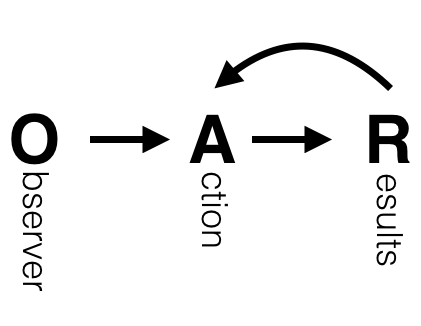
In the ontological approach to coaching, there is a model that with the acronym OAR, where O is the observer, A are the actions and R the results. In life we are often taught to focus on the latter two: first we do stuff and in return we expect stuff to happen. When the results don’t go as we want, we change the actions, or repeat them twice as hard.

Seldom, do we consider the fact that the range of actions that we observe, might not be the entire and only options. In other words, we see things entirely from our perspective. Which is only human, but also limiting.screen-shot-2016-11-26-at-15-06-00

The model suggests that if we widen our perspective as observers, then the range of possible actions and potential results will also increase.

The boss who “always” seems to make the “wrong” decision?

The spouse who “never” understand what you want?

The stranger that voted the other way to you?

It seems to me that their is often no absolute “right”, no definitive answer. Just people observing, making actions and seeing results. And given the different experiences, different lifestyles, different upbringings and existences we have, the range of observations are going to be entirely different too.

We like to believe that we are enlightened and that others some how need to catch up to our perspective. But what if, instead, we chose to try and understand the point of view, ask ourselves what they might see that we don’t, what they might understand?

They. Their. Them.

Entirely natural, but unhelpful. And ultimately limiting ourselves as well.


Our technology is making us dumb

Stand on any street corner and watch people going about their business and you’ll see a curious sight, so many people looking down. Locked in to their personal experience with technology. There was a time when it used to frustrate and annoy me as I made my way to work; the people stopping, walking aimlessly, unaware of their surroundings.

But now, more than ever, it not only annoys, it fundamentally scares me.

Technology was supposed to be the great emancipator, the leveller, it was supposed to open the doors to new horizons and new opportunities. But the reality is not one of bright new dawns, but closing doors. We are narrowing our experiences and polarising our attitudes at a time when we need to be more thoughtful, more explorative, more inclusive than ever.

Our social networks through their definition are based on people “like us”, we share news and comment that we agree with, with people that agree with us. Anyone who wants anything to the contrary can be muted, unfollowed, exiled in from our social existence. The opinions reinforcing our views and the assurance that “we” are “right”.

We “choose” our media, the things that we watch, listen to, read from an increasingly reduced selection of “things we might like”. Losing the ability to have the serendipitous discovery, the accidental opportunity. Instead allowing algorithms to serve up our future, based on what we once consumed, reducing our experience to predictable similarity.

And we close ourselves off from the world, plugging our ears with preselected sound, looking down to view limited content, basing our existence on the screen, not the world. We eschew the chance conversation, the momentary eye contact and smile, the haphazard interaction. We close off the sounds of life, anaesthetising ourselves from reality.

In a world that feels increasingly polarised, where the signs of social isolation and abandonment are becoming central drivers of our political and economic existence. In a world where we talk about the need to be more inclusive, more open, more tolerant and understanding. We are instead shutting ourselves away in closed systems of ignorance.

It would be asking too much to change, to reverse and renew. But perhaps if we were all a little more aware of our choice to have no choice, of our willingness to give away freedom, then we could recognise the limitations of our existence and challenge ourselves to step outside more. To break out of our circles of similarity, to experience difference and to venture more in to the unknown.