Everybody hates your project name

One of the strange things about the corporate world is the love of a project name. We create these with the stated aim of confidentiality, rather than call something what it is – we give it a “project name” so that no-one will ever know what we’re working on. The corporate halls are filled with projects named after gem stones, countries, animals, plants and pretty much any other grouping that you get taught about in kindergarten.

Don’t get me wrong, there are clearly big commercial projects and programmes that require the sort of confidentiality that comes with a project name (and normally a Non Disclosure Agreement) too. But there are also a hell of lot where it simply isn’t necessary. I’m not naive, I recognise I’m not going to change that, too many people are circling back, to move the needle on project names and sometimes taking them offline to create a win win.

You get where I’m going…

But I do want to talk about those people related changes and why your project names are bad for you, bad for employees and bad for your business. HR loves a project name, because it makes us look special, important and allows us to hold power through secrecy. We create these because it makes US feel special, but ultimately disrupts the business more than necessary and makes us look like fools.

Fresh Start!

One Team!

Fit for the Future!

Reset!

Chrysalis!

Re-vision!

(The exclamation marks aren’t necessary but whilst I write this my inner voice is taking control)

The first reason not to do is this is the names are always divisive. The people coming up with them are seldom impacted by the change other than having to implement it. Whereas the people who have their lives turned upside down due to rubbish piece of branding have to go home and tell their families that they might not be able to pay the bills because of a project named after insects transforming.

The second reason is you create a “thing”. Organisation memory lasts longer than most leaders. It is much more likely that people will remember and talk about the impact of, “Fit For The Future” rather than the time they changed the management structure. The point of a brand is to make it memorable, but on people related change you want quite the opposite – you want people to move on as soon as possible.

And the final reason is it stops you thinking about the people. When you start to measure success in relation to a project, and stop measuring it in terms of the impact of people’s lives you fulfil all the stereotypes that people have of management and leadership. Imagine you were managing Project Cause No Distress. What decisions would you make then?

Sometimes changes need to take place in organisations, that goes without saying. Our job is to implement them with as little unintentional impact as possible and to help individuals, teams and the organisation to heal and move on as quickly as possible. There’s no project name ever created, that’s additive to that.
Thirty years of HR-t

A letter came through the door last week with a certificate from the CIPD marking 30 years since I first joined. Alongside inclusion in the HR’s Most Influential Hall of Fame, this was clear proof that I’m now old…a “veteran” as I’ve been described. Ouch.

Over the 30 years, I’ve never once hesitated paying my membership fees, because I value the work that the CIPD does. I know that might sound strange to some people who would expect me to criticise them (more of that later) but I genuinely believe they do an important job in a difficult context where it is hard to please everyone and sometimes even anyone. Like any long standing relationship, you have ups and downs. You tolerate things that used to irritate you and you get irritated by things you used to tolerate. But good relationships are based on honesty, constructive challenge and always wanting the other party to be better for themselves, not for you.

So let’s start with the good stuff. When I qualified the IPD had just been formed through the combination of the Institute of Personnel Management and the Institute of Training and Development. I became a GradIPD and I was genuinely proud, even more so in 2003 when that became the CIPD. Professional standards are important, particularly in a profession without the mainstream understanding of the law or accountancy for example. To this day, we put people through their CIPD qualifications in my organisation and it matters to them like it did to me. That chartered membership is a standard that should be championed and cherished in making the profession known and widely recognised.

Whilst the CIPD is at its best when it is championing high standards, it is at its worst when it starts to stray into social policy. The partnership with the High Pay Centre to champion “Fat Cat Monday” was frankly bonkers given the, at the time, very outspoken leadership of the HPC and something that anyone with half a brain should have understood placed its members in untenable positions with their remuneration committees. They’ve got themselves in a high profile mess over trans rights too, and their bias towards knowledge workers rather than the front line blue collar workers stems from a like of social, economic and intellectual diversity in their ranks. They have super bright people in the organisation, but I sometimes wonder whether there is a bit too much group think and a bit too little sense of strategic direction.

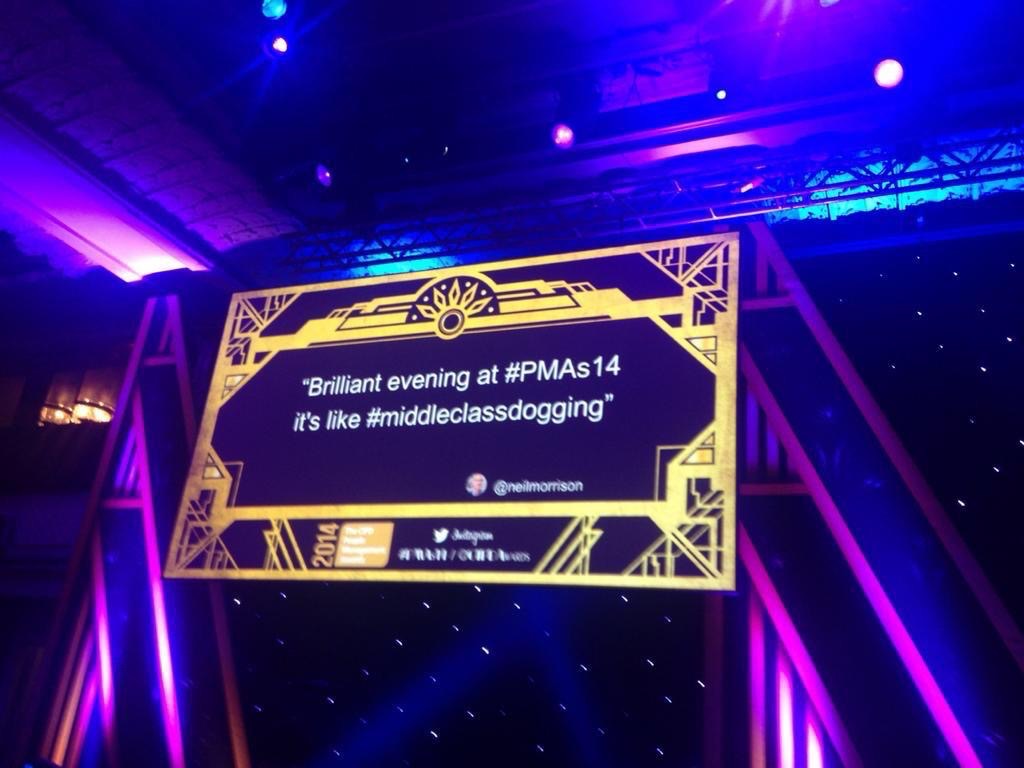
Over those thirty years we’ve had some fun too. Who can forget the imbecilic “Think HR, Think Again” marketing campaign. There was more “thought” in the strap line than there was in the conception of the ridiculous short lived campaign. There was the time in the early days of social media where they struggled a to get to grips with hashtags being used to drive feeds, leaving a few of us to swamp their website with irrelevant humorous content and being eventually given a stern dressing down by their social media team. And of course, the pièce de résistance when I managed to put a rather inappropriate message on the large screens at the 2014 People Management Awards (image below).

So 30 years in, CIPD it has been a blast. Keep championing better work, keep making people proud to qualify, remember our job is to drive the productivity of individuals, teams and organisations and not to tell people how to think or what to believe. And please, for the love of Buddha, don’t do another marketing campaign like that one. Here’s to…well not another 30 years, but who knows…maybe another 10.

I can only apologise.

Let the lawmakers make law

I hesitated before writing this post, there are some topics that I’ve seen over the years tend to draw the wrong kind of audience, the ones that want winners and losers, the ones that want to blame and point fingers, the ones that – no matter how many caveats or waivers you include – want to read hidden meaning into the words that you write. But on the flip side, there are more people in the world that want to reflect, consider and discuss than there are those that want to provoke.

So perhaps unsurprisingly, for a UK audience, my thoughts are on the Supreme Court ruling in the last week on the legal definition of a “woman”. But, (and here come the waivers) I don’t want to talk about the decision, the opposing arguments, the rights or the wrongs. I want to talk about the role of leadership and organisations and how they organise themselves for their employees and customers in a broader ecosystem.

One of our primary responsibilities is to act within the law. Over the thirty years I’ve been running businesses I’ve seen a whole host of legal decisions, some that I’ve agreed with, some that I haven’t. But that doesn’t really matter, because my role is not to make law, but to run my business. The simple fact is that the ruling last week has brought clarity on an area that was previously driven by opinion and belief (often in conflict with others) and so any leader should welcome that clarity, even if they may not personally agree with it.

Organisations get into trouble when they are led not by the law but the beliefs of a few senior people and I’ve written before about the dangers of business moving into social policy. My guess is that some organisations who’ve been doing that will be left scratching their heads at the ruling and trying to figure out how they reconcile the approach that they’ve previously taken, based on some half complete advice, with the direction they’ve just been given, based on the law.

Of course there will be those that don’t agree with the judgment, like there will be those that don’t agree with the outcomes of elections, referendums or the actions of government or the authorities. But ultimately, the reason we have these mechanisms in our society is to make these decisions for us and to give us the clarity to operate within the parameters we are set. In the same way there is no point in calling the electorate stupid for voting for a different outcome than the one you want, there is no point in suggesting the Supreme Court judges made a poor decision unless you have the knowledge, understanding, means and wherewithal to challenge the technical legal points. We should remember, that the judges were faced with a specific question, not given an open opportunity to opine.

The politicisation of business over the last decade or so hasn’t, in my opinion, been a positive step forward. There are very few founder led businesses who can essentially do their bidding, the rest of us should focus on our stakeholders, customers, shareholders and employees and knuckle down to deliver. If we’d been doing that, rather than making statements, the ruling of the Supreme Court would have been significantly less sensational, regardless of the decision they landed on. And we would have spent more time, focusing on those things that we truly had under our control – which is what we all need to do right now.

Mistakes are the things that make us

One of the questions I often ask in interview is around mistakes in the past that have made people who they are. The way in which people talk about them, the way in which they react and the learning they take from them is often fascinating. Of course, I’m not really interested in the mistake in itself, what I’m really interested in is firstly the sincerity with which they talk about the issue and the way in which they incorporate it into their leadership and management style.

How you handle mistakes can be fundamental to how you develop as a leader. There are two clear mistakes that I see people make;

  1. Applying a kind of cognitive dissonance that seeks to apportion blame to others and absolve yourself of personal responsibility. Whilst this can be a useful tool in certain circumstances, there are very few situations that we can’t learn something from if we are willing to hold our own actions and decisions up for assessment.
  2. Dwelling on a decision or issues to the point that it prevents us from being able to move onwards. People get stuck on a particular situation or moment and that makes them act differently or inhibits them without having really processed the learning.

It can be hard in the moment to get the right balance of reflection and self assessment without becoming stuck in the moment, so here’s how I think about it for myself.

  1. Deal with the issue at hand first. When things go wrong the first thing is to try and rectify the issue and provide a way forward for whatever it is you’re facing into. There is zero benefit to be gained from over analysing whilst there is still an outstanding issue or problem to be solved.
  2. Give yourself time to properly assess what happened. Our brains can make simplified versions of past events pretty quickly and sometimes that skips details or moments that we genuinely learn from. The shorthand is useful to get us through the immediate issue, but when we have time we need to unpack the full unadulterated version.
  3. Be ok with identifying things you both could and couldn’t do differently. As with any action planning, you need to be able to own and take those steps, so be equally clear with the things that you wouldn’t be able to change in the future as those that you want to build into your leadership going forward.
  4. Put it in a box. Once you’ve kicked it around and figured out the learning, put the experience into a box, put it at the back of the mental cupboard and close the door. Only hold on to the learning not the event or moment itself, it won’t serve you well.
  5. But, hold onto the feeling. Remembering how you felt when you made a mistake is a great way of using your whole body to help you to achieve better outcomes in the future. When I ask people the question in interview, I can immediately see those that held onto the feeling.

One thing we can all be sure of is that mistakes happen, they will happen to all of us throughout our working lives. What we do with the experience, how we use it to drive us forward is the thing that makes the biggest difference. And sometimes that also means moving on.