Some are more equal than others

I’ve been a great believer in initiatives to improve the gender imbalance and to focus on diversity of all kinds. I genuinely want to be inclusive.

But the more I look at it, the more I think that most of our actions are just window dressing. I wonder if we’re acting, but essentially undertaking institutional appeasement. Saying the right things, whilst nothing really changes.

What if business is essentially a masculine construct, with male rules and the only way to succeed is by being more male than the men?

I wrote a post back in 2013 called “Just a middle class white guy” and reading it now I think I only scratched on the surface of something that actually significantly hampers our ability to genuinely leverage organisational performance

Not only are all our rules are stacked in favour of men. We’ve taken the rule book and hidden it behind third urinal from the left.

When we go for an interview and they are looking for qualities like “commercial”, “decisive”, “confident” or “ambitious”.

When meetings are ruled by the “single minded”, “focused”, “action orientated” and the “natural leaders”.

What are we really talking about?

Of course, I’m not saying that women don’t have these characteristics or indeed that men automatically do. What I’m saying is that our laziness and sloppy use of language hides a darker truth.

We build our assumptions of success based on the evidence that we have around us. But if that evidence is based on an uneven foundation, are we sure that we really know what is genuine success?

We reward, we promote, we recruit and we develop people in the model of business that is built on a masculine premise. We tell people that they need to be more like our predetermined view of the “norm” if they are going to succeed. We develop them towards this and reward them when they comply.

The more that I look at it, this won’t be solved by initiatives, campaigns or well-meaning propaganda. This will only be solved by wholesale reform and re-engineering of organisational culture and practice by the “male types” that run them.

But most likely, it just won’t. Or at least, not any time soon.
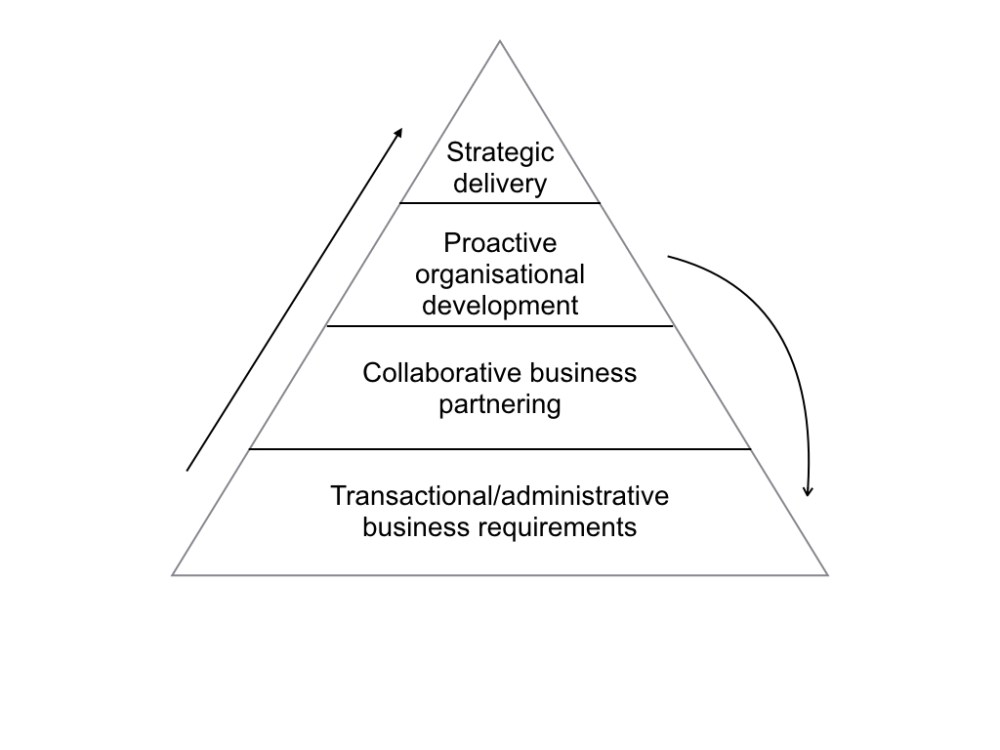
The hierarchy of HR needs

As a business function we exist to add value to our organisation and their employees. If you ask any experienced HR professional where they would like to add value, you’ll most likely be told in a more “strategic” space. Ask a CEO the same question and you’ll probably hear much the same answer.

So if the desire is from both sides, what gets in the way?

Putting aside questions of capability to deliver at this level for the moment, the answer lies in the hierarchy of HR needs and HR delivery. Put simply, we try to do too much too soon, without delivering on the basics.

Let’s consider a simple HR hierarchy,

HRhierarchy.001First we need to fulfil the basic reactive, administrative personnel tasks that represent most employees’ experience with the business. The recruitment, the payroll, the benefits administration and grievance, disciplinary and performance management.

Next comes partnering. By this I mean working collaboratively with business leaders to tackle the issues that arise in a broad range of areas on a day to day basis. This isn’t just implementing th administration, but understanding the issues and helping to form solutions.

Once we’ve got this we can use it to inform the development of more proactive organisational interventions that are underpinned by, and drive the design of, the basic, reactive administrative tasks that form the base of our value proposition. In some ways, these first three stages operate as a continuous loop.

This is also the stage where we can start to successfully implement technology solutions to automate the interventions, but based on the organisational understanding that comes through true partnering.

Finally comes strategic delivery. With the three stages below working and constantly informing one another, we can use this feedback loop to help understand our strategic capability.

We can understand the gaps that exist between our future requirements and current capabilities, we have the data and insight that allows us to understand the steady state performance and we can use our knowledge to help connect this to the external opportunity.

Being strategic isn’t a goal in itself, it’s an outcome. If we can build our capability based on this simple model, then we can help more people deliver what we, and our CEOs, most desire.

Not a bad challenge to address as we start the New Year.

The great engagement swindle

I’ve written before about employee engagement, but its a subject that can’t take enough kickings.

I’ll put it simply, employee engagement is the biggest corporate swindle since Asil Nadir thought, “no-one will notice”.

Let’s be clear:

Engagement does not pay the bills.
Engagement won’t cover your medical costs when you take a fall.
Engagement won’t keep the heating on in your retirement.
Engagement doesn’t make you healthy or happy or even a better lover.

Engagement doesn’t even have a standard meaning, definition or measure. It’s a fabrication.

The biggest con about employee engagement? The goal is to drive commercial success, whilst dressing it up as employee welfare. Look at any purveyor of employee engagement services and they will talk about driving business performance.

Employee engagement doesn’t replace talking to people, caring for people, listening to people. It doesn’t replace paying people well, investing in their benefits and providing a decent pension scheme.

Do things right as an organisation, treat people well, don’t treat them like fodder and you’ll be surprised how much they’ll do for you. Not because they’re engaged, but because they want to.

How about we measured leadership engagement instead? How engaged is your leadership team with employees? How well do they know them? When was the last time they had a human to human conversation with someone in the organisation they didn’t know?

Employee engagement is the classic example of human resources forgetting about humans and focussing on resources. It’s bad mumbo jumbo dressed up as science.

Employee engagement is an idea that’s long over stayed it’s welcome. Let’s kill this vacuous, malevolent concept once and for all.

Information is energy, not power

How does your organisation treat information? I mean proper information, the stuff that makes a difference.

The organisational response to feedback about their information flow is normally one of two things, to instigate more formal information sharing platforms, to berate management for not cascading the content of the already existing platforms.

Meanwhile, the real information flow in the organisation doesn’t change. Because it isn’t a process, it’s culture.

We all know the phrase, “knowledge is power” but the reality is that in far too many of our organisations information is being used as such by a large proportion of our people.

It strikes me the leader’s job is to use information as energy and not as power. We are there to disseminate the appropriate information at the right time to aid performance but also to retain information, to shield people if that information would hinder performance.

And that’s a fine balance.

I don’t buy the idea that total absolute information flow is the organisational gold standard. The demands to know everything is a simple means of recognising that information is seen as power within your business.

We all know that organisations produce ridiculous amounts of data and also, particularly in these fluid times, the agenda can change repeatedly. Sometimes it just isn’t helpful to know.

Culturally advanced organisations know when to share and when not to share. Likewise, people in culturally advanced organisations recognise what they need to know and what they don’t.

And that’s where we need to aim.