True choice is sacrifice

The simple truth is that we cannot have everything. Too often we sell the idea, the dream that it is possible to have a little bit of everything and reach the ultimate state of perfect happiness.

Sadly it just isn’t so.

I saw this drawing recently and it whilst it raised a smile, it also highlighted a perfect point:

IMG_0915


Somewhat coincidentally, the same diagram (with different choices) came up in a conversation I was having with the brilliantly clever Deborah Rees from Innecto. This time in relation to compensation (I paraphrase).

IMG_0917


Perhaps the biggest area that I see this most obviously manifest is in work life balance. I’d draw it something like this:

IMG_0916


But the point isn’t one about work life balance.

The point is that choice is about sacrifice as well as it is about selection. When we positively opt for one thing, we ultimately reject another. Whether we can accept this, that is our challenge.

Too often we place the responsibility on others, the company we work for, the government that runs our country, our friends and family.

To much of our organisational focus has historically been on trying to pretend that everything is possible and we can provide and fulfil employee needs on every level, even when they’re conflicting. That we can offer everything, without sacrifice and, as an unintended consequence, ultimately disempowering the individual.

When, logically, choice should be wholly individual, have resultant consequences and require sacrifice. And as HR leaders, our job is to explain and facilitate that, not try to pretend that it isn’t so.

As we set about designing the organisations of the future, we should be creating environments where transparency, choice and genuine empowerment flourish, where individuals are aware and accepting of the pros and cons of their decisions.

The choice that you make will be different from the one that I make and that’s absolutely fine. The challenge is to understand and be personally accepting of the compromise that we will inevitably have to make.

Because we can’t be and we can’t have everything, we will always have to choose.

A letter to Penny

Dear Penny,

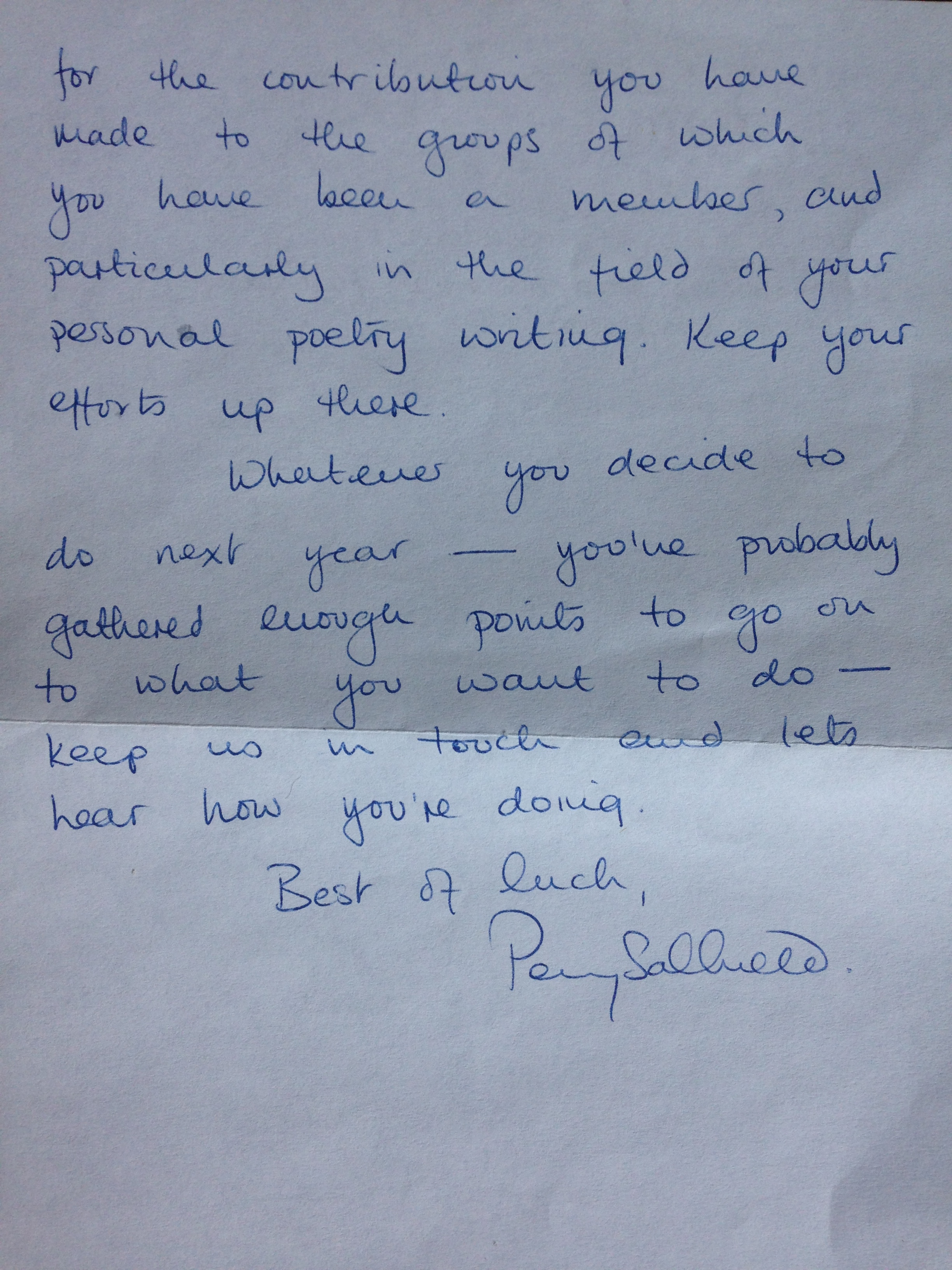
I wanted to write to thank you for your letter. I realise that replying to it twenty-two years after receipt is probably considered bad form. But then, at the time, I wasn’t ready to reply. And it was only this weekend that I was going through some boxes that I came across it and read and appreciated it.

photo 2

photo 1

Not missing the irony that, of course, this week people will be getting their own A-level results. And some of them will feel like I felt, back in 1992.

The strange thing about education, about our system is that we place so much importance on that very short period of time. You know, you and a few of the other teachers were absolutely right. I needed to go, I needed to get away and I needed to see what I could make of life.

At the time I was too obsessed with the opportunities that I saw diminishing before my eyes, to realise the world of opportunity that nonetheless awaited me. “But I was supposed to…” was the phrase that kept on going through my mind.

But life isn’t about “supposed to” or “should have”, life is about “can do” and “did do”. It took me the best part of twenty years to realise that. Before then I was too busy wanting to stick two fingers up to the past and show people I could be a success. I guess in some ways I’m grateful that this was my reaction to failure, rather than to get subsumed by it. Some people do.

The simple answer to your question though, is that I’m doing well. Life has been good to me, we’ve been successful and healthy and happy together. I’ve got to do things that I would never have dreamt would have been possible in that moment when I opened those results and saw the letters C,D&E. I’ve worked in amazing companies with some of the brightest people in their sectors. And together we’ve repeatedly made history.

And it makes me think that this week, like me 22 years ago, there are going to be people all over the country that are going to feel the world collapse under their feet as they look at the letters that they have on their screens (what happened to paper?)

My message to them is to, “go, get away and make what they can of life. Focus on what you can do and will do, not what you can’t do or won’t do. Your world feels limited, reduced and cruelly diminished. But your talents aren’t. You are everything that you were before and more. And you will be even greater still”.

With a bit of luck, they’ll have had teachers that cared for them, that nurtured them, that educated them. Not to pass exams, but (like I did) to help them grow. I hope they go out there and prove you right and the system wrong. I want them to be focussed, be successful and be happy.

Thanks for teaching me this Penny. I’m sorry it took me so long to realise and to learn, but maybe that’s why I didn’t do as well as I wanted. I’m a little bit slow. I hope life treated you well and I’m sorry we lost contact. Who knows, maybe the connected world of the web will rectify that.

From the bottom of my heart, thank you.

Neil

PS. You’re too kind about the poetry, it was always a bit crap. But I guess I’m still writing, so that’s ok?

NB. If anyone happens to know the whereabouts of Penny Salkield, it would be my absolute pleasure to thank her in person.

We are our choices

Can you imagine being told by your supermarket what you had to buy? Or your hairdresser telling you how your hair should be cut? How about local bar or pub deciding what you wanted to drink? I know for one that I wouldn’t put up with it and I guess is that it wouldn’t take long for you to get fed up either.

Because we like the choice. We like the feeling of control. We like to be in charge of our own destiny. Now of course, we could debate for hours, whether we are actually in control, or having the living daylights manipulated out of us on an hourly basis. But stay with me.

It’s well known that the idea of a “war for talent” makes me want to self castrate with a rusty set of hair clippers. I’m also not going to go down the Gen Y debate, because there are too many haters out there and I can’t be arsed.

But. And this is a big but (no jokes please). I do think the relationship is changing between employers and employees.

Yet, so much of what we do is still grounded in the paternalistic past where the boss knew best. How we pay, how we offer benefits, how we train and develop. How we promote and manage careers.

We provide very little choice in organisations, very little flexibility and very little responsibility. Instead we standardise, homogenise, process and commoditise the employment relationship. Partly because it makes things easy for us, partly because it retains control.

But it misses a trick. If the future of employment relationships is less permanent, less linear and generally more two-way. Then shouldn’t we be designing our organisations to genuinely give choice and ownership to employees? Not merely paying lip service to it.

It is nice to talk about the way that management is going to change. The way in which the organisation is going to change. The way in which careers are going to change. But how is the organisational infrastructure going to change and who is thinking about it?

That’s what I’d like to know.

Your happiness is your responsibility; it’s time to quit your job

Over my career I’ve been able to identify the single biggest cause of employee dissatisfaction. That’s been working across multiple sectors, in different roles and in different conditions.

It isn’t compensation
It isn’t development
It isn’t promotion

It’s something that is completely out of our control.

It’s regret. The regret of failing to act.

Life is full of events over which we have no control, life is full of changes which we cannot influence. We can sit idly by and bemoan the fact that things aren’t what they were, that life has dealt us the hand that we didn’t want or that people are doing things or behaving in a way in which we disapprove.

We can’t change any of these things. But we can always act.

Unsurprisingly, these two things are often confused. The response is, “but I can’t do anything to change [insert cause of issue]” and the answer is always, “so what can you do?”

Ultimately we are all responsible for our happiness, we are responsible for finding our own peace and for ensuring that we make the most of our life both in and outside of work.

And that means accepting responsibility that we can act and our failure to act, not the change, leads to our regret.

In a work context, that often means leaving a company where you’re unhappy. I’ve seen too many people become under performers, become organisational hostages, become “that guy” in the canteen that everyone tries to avoid, become the source of dissatisfaction of others, simply because they failed to act.

Or it means accepting that sometimes change happens, the past is exactly that and we need to move on. In either case, this is a choice, a conscious decision that each and everyone is able to exercise.

Life is too short to sit, being unhappy and blaming others.

“Il n’y a de réalité que dans l’action.”

The only reality is in action.