I am legend

Here’s a question;

When you leave your organisation, will you leave it better or worse than you found it?

It’s a pretty pivotal test for all of us, even more so if you are a senior leader or a CEO.

Have you extracted more value to your organisation than you’ve added? Is it better for having had your presence? Will it be after you’ve gone?

The simple fact is that we are all caretakers. Our job is to leave our organisation in at least the same state as we found it and our focus and intention should be to leave it even better.

It isn’t easy. Our financial markets, our economic model compel us to extract value and to return it to shareholders. Our leaders are rewarded for it, in this imperfect model.

Even in not for profit organisations, the public and third sector. It is very easy for egos and personal agendas to cloud the perspective of leadership teams.

It doesn’t matter what circumstances our business is under, our thoughts should always be beyond our own safety and security, our own comfort, our own personal gain.

Our reward should not be in personal adulation, false empires or the trappings of power.

Our reward should be knowing we’ve left a sustainable legacy.

We should not put off the decisions, hide from the challenges or avoid the truths of today, but face them head on to create the hope for tomorrow.

When we leave our organisations, we should leave them ready for the next generation to build and grow. We should leave them fit, healthy and ready.

Judgment is not when we are in situ, but when we are not.

So when you’re facing a tough decision, a change, a need to repurpose, rethink and realign. Ask yourself not whether this suits the needs of now, but whether it has to be done for tomorrow.
Delivery is everything

If I had one single wish, something that I could change about the world that we live in, it would be to ensure that people delivered on their commitments.

The amount of time that is wasted chasing others to follow through, courier companies, our public services, utility companies and of course colleagues at work. The time is totally unproductive – in and of itself, it moves nothing, adds no value, creates no meaning.

And think about those services that pretty much always deliver, the restaurant where the service is faultless, the retailer who always hits their delivery slot, the bank that can always help. The delight that is created through the consistent and regular fulfilment of its stated obligations.

In a world where the consumer is king, delivery is divine.

My advice to anyone entering in to a career in HR, that wants to change the perception of the function and profession, is to focus on delivery as a critical tenet of your strategy, both personally and as a function as a whole.

When dates are set, keep to them. When promises made, fulfil them. When actions agreed, complete them. If you want to create the promised delight, then the delivery of the solution is as important as product. And that repeats every day.

There’s a phrase in restaurant kitchens, “you’re only as good as your last service”. If you want to make a real step change in your organisational perception, take this to heart and realise that consistent delivery is key.

In fact, it’s (almost) everything.

The myth of entitlement

Throughout the entirety of my career, I’ve repeatedly come face to face with two of the most common myths within the workplace;

  1. Organisations somehow owe something to employees
  2. Employees somehow owe something to organisations

As if there is some unwritten obligation to be fulfilled.

There isn’t. This is the myth of entitlement.

Organisations are collaborations that exist to serve others. There is not a single one, private, public or third sector that exists to serve the needs of its employees. Not one.

And likewise there is not a single employee that exists to serve the needs of its employer.

This misapprehension is reflected in our professional practice and driven by our inability to understand the basic economic transaction that exists within the workplace.

Organisational purpose is delivered by labour and labour is rewarded for that delivery.

But before I’m accused of taking some neanderthal backward step to the dark ages of lords and masters, let’s also be clear about a few other things.

  • Employees have choices. Most organisations have doors and people are free to come and go as they choose.
  • Employers have choices. Employment is not guaranteed and organisations are free to hire and fire as they choose.

The relationship that brings employee and employer together is one to organise labour to deliver collectively for a defined purpose. And that purpose is the economic driver and the one and only reason that both exist.

Far from being backward, realisation and acceptance of this is the key to understanding and building an adult relationship within the workplace. It is central to building a healthy and sustainable organisational culture that understands the balance and trade offs that exists.

Yes so often it is missing and instead replaced with an over inflated expectation of our worth and our value, both as an employer and employee.

Strong healthy employment relationships are psychologically the same as any other relationship. They require balance. And they require an acceptance that if that balance is broken, if the needs are not being fulfilled, either party has the freedom to act.

The hierarchy of HR needs

As a business function we exist to add value to our organisation and their employees. If you ask any experienced HR professional where they would like to add value, you’ll most likely be told in a more “strategic” space. Ask a CEO the same question and you’ll probably hear much the same answer.

So if the desire is from both sides, what gets in the way?

Putting aside questions of capability to deliver at this level for the moment, the answer lies in the hierarchy of HR needs and HR delivery. Put simply, we try to do too much too soon, without delivering on the basics.

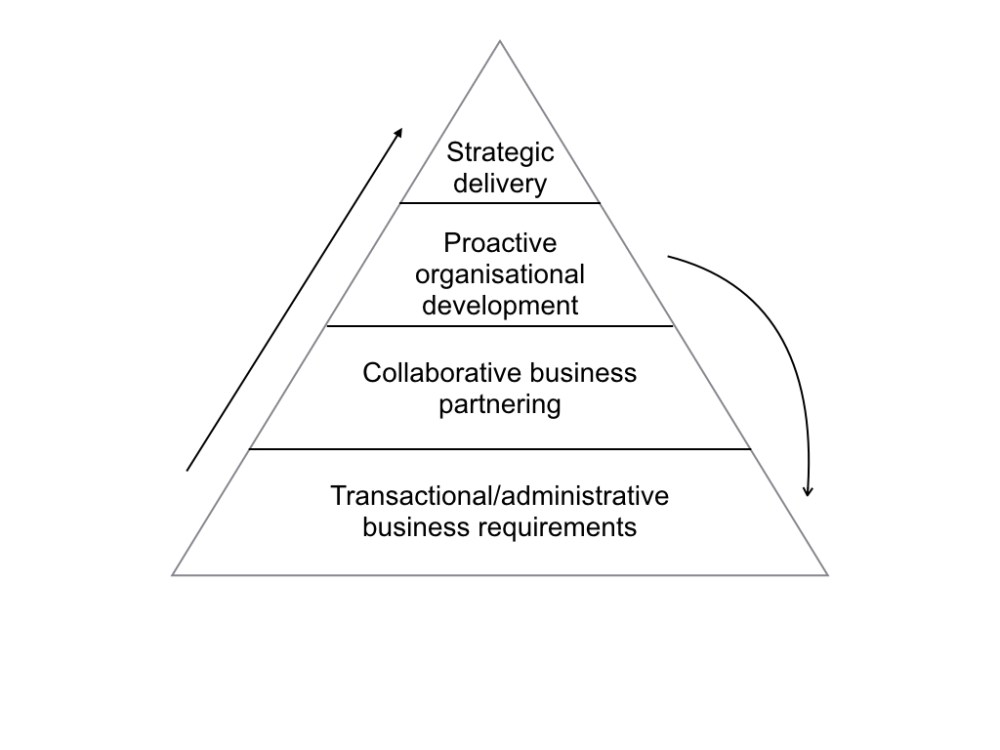
Let’s consider a simple HR hierarchy,

HRhierarchy.001First we need to fulfil the basic reactive, administrative personnel tasks that represent most employees’ experience with the business. The recruitment, the payroll, the benefits administration and grievance, disciplinary and performance management.

Next comes partnering. By this I mean working collaboratively with business leaders to tackle the issues that arise in a broad range of areas on a day to day basis. This isn’t just implementing th administration, but understanding the issues and helping to form solutions.

Once we’ve got this we can use it to inform the development of more proactive organisational interventions that are underpinned by, and drive the design of, the basic, reactive administrative tasks that form the base of our value proposition. In some ways, these first three stages operate as a continuous loop.

This is also the stage where we can start to successfully implement technology solutions to automate the interventions, but based on the organisational understanding that comes through true partnering.

Finally comes strategic delivery. With the three stages below working and constantly informing one another, we can use this feedback loop to help understand our strategic capability.

We can understand the gaps that exist between our future requirements and current capabilities, we have the data and insight that allows us to understand the steady state performance and we can use our knowledge to help connect this to the external opportunity.

Being strategic isn’t a goal in itself, it’s an outcome. If we can build our capability based on this simple model, then we can help more people deliver what we, and our CEOs, most desire.

Not a bad challenge to address as we start the New Year.