Nobody needs feedback

Of all the sickening management constructs that we’ve introduced into the workplace, the industry around feedback is perhaps the most pervasive and unhelpful. We are living in a world with a constant pressure and need to seek and give feedback but without really considering to what end.

A quick Google search for “feedback at work” shows just shy of a billion articles. A billion articles written about something that didn’t really exist until the middle of last century. And in that time, have we seen workplaces become happier? More productive? More enjoyable? Or have we seen the reverse?

The problem is, that over 90% of feedback is unhelpful. It doesn’t actually make anything better, doesn’t make anyone improve, doesn’t facilitate learning or enlightenment. If you don’t believe me, consider this:

What is the most useful piece of feedback you’ve received?

I bet you can think of one, an incisive and helpful moment. Now, place this piece of feedback in proportion to the entire amount that you’ve been given over your life. And quite frankly, I’d be surprised if it doesn’t fall into insignificance. You will have been given more pointless, unhelpful and sometimes dangerous pieces of feedback than helpful ones, probably to the power of ten.

The other issue with feedback is that it is, by nature, entirely subjective. And therefore is subject to bias. When you receive feedback you’re not getting the truth, you’re getting opinion. And that opinion is only one set of data. So on any, genuine, scientific basis it would be completely unreliable. There are no controls, there are multiple variables, it simply would not pass muster.Yet in organisations, we treat it as a means for development.

Here’s the thing. If you want feedback on something, or from someone then fine. Go and ask. But if people start telling you that you need it, or your organisation starts telling you that it wants to develop a feedback culture. Run like the wind. Or simply put your headphones on. You’ll end up wasting time, being confused, getting contradictory messages and choosing to believe only the information that supports your own confirmation bias – whether positive, or negative.

Feedback in organisations? Its something nobody needs to “see more of” and we could all do with “doing differently”. “Stop” the obsession with it, “Start” thinking more creatively, “Continue” getting on with your jobs.
Shift your perspective

If nothing else, 2016 has shone a very strong and revealing light on the seemingly polarised nature of society. Our ability to see, hear, repeat and convey from a singular point of view.

“They just don’t get it”

“Why can’t they open their eyes?”

“It’s right in front of them, they’re just too…”

They. Their. Them.

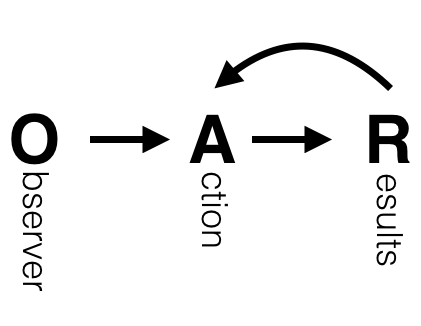
In the ontological approach to coaching, there is a model that with the acronym OAR, where O is the observer, A are the actions and R the results. In life we are often taught to focus on the latter two: first we do stuff and in return we expect stuff to happen. When the results don’t go as we want, we change the actions, or repeat them twice as hard.

Seldom, do we consider the fact that the range of actions that we observe, might not be the entire and only options. In other words, we see things entirely from our perspective. Which is only human, but also limiting.screen-shot-2016-11-26-at-15-06-00

The model suggests that if we widen our perspective as observers, then the range of possible actions and potential results will also increase.

The boss who “always” seems to make the “wrong” decision?

The spouse who “never” understand what you want?

The stranger that voted the other way to you?

It seems to me that their is often no absolute “right”, no definitive answer. Just people observing, making actions and seeing results. And given the different experiences, different lifestyles, different upbringings and existences we have, the range of observations are going to be entirely different too.

We like to believe that we are enlightened and that others some how need to catch up to our perspective. But what if, instead, we chose to try and understand the point of view, ask ourselves what they might see that we don’t, what they might understand?

They. Their. Them.

Entirely natural, but unhelpful. And ultimately limiting ourselves as well.


Conversation is not enough

In a country still reeling from the largely unforeseen referendum in June, the US election result added a further sense of discombobulation to the many attendees at the CIPD Conference last week, who reacted to the unexpected news on Wednesday morning with a level of predictable hysteria.

A lot of the debate at the conference followed the theme of the future of work and making work more human. Themes that I (and others) have been implementing, writing and talking about for over five years. And whilst it is great to see the mainstream finally adopt the same agenda, it fills me with a deep and profound sense of unease.

Both electoral outcomes were largely unseen by the liberal elite, the same people that talk of making work more human. Both outcomes were partly driven by a sense of societal injustice, unfairness and frustration with the role that the establishment has played. Or perhaps, more accurately, the role the establishment has not played.

If we believe in fairness, if we believe in humanity, if we believe the future of work is indeed human, it is beholden on us to do less talking and more acting. Positive outcomes are not achieved through well meaning dialogue but through the actions we take and the changes we make. Positive outcomes are not achieved in the warm bubble of elitist consensus, but by taking ourselves out of our comfort zones and listening more than we talk.

We have to accept that “we” have got things wrong, not “them” and that “we” can make the change, not “them”. We have to accept that the inequalities in work, housing, education, society come from our hand and from the hands of our like. But that we can also make changes that matter, right here, right now.

In my darker moments, I fear we do not have enough time and that ultimately the change that needs to be made will be provoked by external circumstances out of our control. That the burning platform will not be lit by our hand. But if there is a chance, if there is an opportunity, if we have a moment in which we can change things for the better, it will surely only come from meaningful, visible action, and not well intentioned, but impotent talk.

Leaving the conference I got in to a cab to go back to the station. The driver asked me where I’d been and what sort of things I spoke about. When I explaned, he replied, “Good luck with that! It’s dog eat dog out there. Don’t get me wrong, I agree with the sentiment, I just don’t see how it is ever going to happen”.

Unless we start to act, I think he’s probably right.

The negative power of change

I’ve written before about my loathing for the disproportionate use of the term “disrupt”. It is a lazy, attention seeking way of trying to be heard in a world where innovative, creative thinking is at a minimum and noise and kerfuffle cloud the air of rationality. In many ways, disrupt is the bastard offspring of “change” – another overly used terms that was bandied around liberally with the hope of appearing clean and fresh and new.

Most genuine disruption and change which involves humans is potentially painful. That’s why placing it in the hands of people who fail to understand these consequences is both dangerous and naive. It is also why I have fundamental reservations about anyone who professes to “love change”. Maybe some change, but all change?

The are organisations that have become dependent on change as a means of defining their purpose. They move from restructure, to initiative, to strategic review without stopping to take a breath. These are not the agile or adaptable organisation that they would hope to be, but instead lost and rudderless placing bet after bet hoping that one of them will come home without realising the quantum of their losses.

That is not to say that organisations shouldn’t seek to change, progress and develop. It is not to say that they shouldn’t seek to innovate, create and (maybe) have some disruptive force. But the overriding question has to be, “for what purpose?” What is the reason that we are doing this, what are the imperatives that we need to take in to account, what will be the difference that we will see at the end and how will we know whether we’ve achieved it?

The practices that we use to achieve this, the way in which we work to solve the problems, the means by which we measure and assess will all change, but the overriding context should not. The most agile and adaptable of organisations hardly need to talk about change or disruption, they’re making a million small and seemingly indiscernible improvements every year to be better.

Ultimately, when we’re talking about human lives, when we’re talking about human existence and experience, we need to be respectful, mindful and thoughtful about the implications on everyone within an ecosystem of the actions that we take. Loving change is one thing when you’re doing it, another when it is being done to you.